
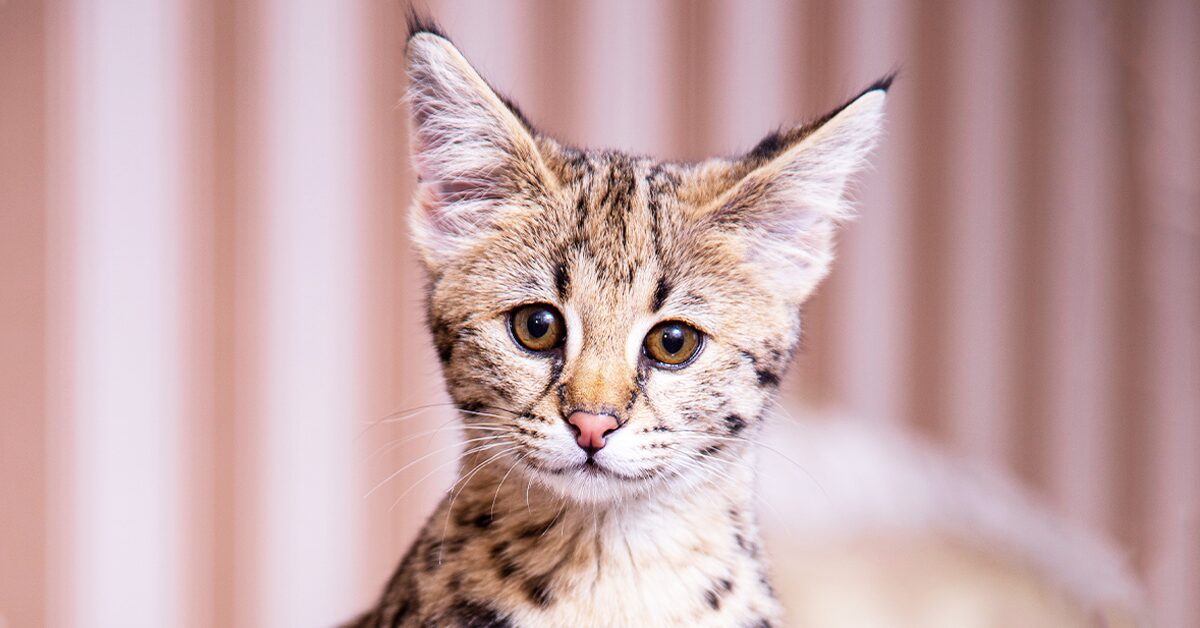
Meet the Savannah Cat

Best Fur Friend

High Kitty I.Q.

Top Cathlete
Looking for an exotic-looking kitty with a dog-like personality? I’m the breed for you! We Savannahs have wild ancestors, but I’m the purrfectly suited to domestic life. I’m a high-energy, outgoing cat, so I do best with humans who love to play as much as I do. I’m very friendly so I get along great with kids and other pets – the more playmates, the better! I’m curious and adventurous and I’m always on the lookout for something to do. Make sure that I have lots of toys, especially a cat tree – I love jumping and my long legs can get some major air!
My looks are all wild cat but I’m a dog in a cat’s body. I love exercise and I can walk on a leash, play fetch, and even learn commands! I’m not a lap cat but I show affection by following you around and head butting you – it’s how I say I love you! My furbulous coat only needs basic grooming to stay beautiful (I’d rather you spend time playing with me than grooming me). My unique looks and personality make me one of the most special cats around!
Ready to learn more about me? Let’s dig in.

Ready to learn more about me? Let’s dig in.


 My Many Looks
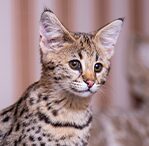
Brown Spotted Tabby
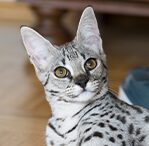
Silver Spotted Tabby
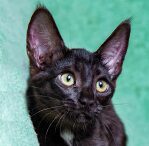
Black

Black Smoke
 My Breed Characteristics










 Furbulous Fact
Lots of cats hate water, but not me! We Savannahs pawsitively love to splash around, which makes bath time a breeze for our humans. I’m a good swimmer and I have been known to drop my toys in water just to fish them out. Speaking of fish, if you have any aquatic friends as pets, keep your aquarium closed – I can’t help myself! You might also want to keep your toilet lids down if you don’t want me taking a dip in places I shouldn’t. All water is the same to me!
 As I Grow Up
As you can see, we Savannahs age pretty gracefully. Here are a few key milestones in my growth & development to be aware of as I grow up from a kitten to an adult and senior!
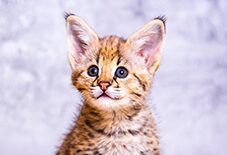
Kitten4-6 Months
I’m super loyal and get attached to my humans so socialize me early with children and other pets – just make sure I have my vaccinations pawlease!
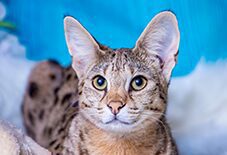
Adult2-3 Years
I’ve got a ton of energy to burn so I need lots of playtime and toys (I get destructive when I’m bored).
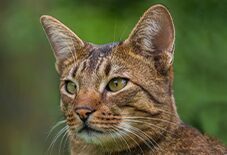
Senior10 Years
I’m prone to teeth & gum issues, so (along with routine vet check-ups) pawlease brush my teeth regularly!
 History of My Breed
We Savannah cats are a very new breed and our history is pawsitively fascinating. The very first Savannah was born in Pennsylvania in 1986, when a Bengal cat breeder named Judee Frank bred a Siamese cat with an African serval. Serval cats are native cats from Africa, so my earliest ancestor was half wild cat! Judee Frank named this first kitten “Savannah” because African servals come from the African savannah, and the name stuck. The first Savannah kitten was what the humans call an F1 Savannah, which means that it is a first generation hybrid cat with a wild serval parent. The F2 Savannah cat is second generation and has a wild serval grandparent.
After the first Savannahs started coming into the world, the humans found us so unique and lovable that we began to catch on. It took my ancestors a while before the humans would consider us a domesticated breed, but in the 1990s two humans – a Savannah enthusiast named Patrick Kelley and a breeder named Joyce Sroufe – came together and developed my breed standard. It took some convincing, but they were finally able to get The International Cat Association (TICA) to accept us in 2001. Because of our wild cat roots, only Savannahs that are at least four generations removed from a serval cat parents are considered fully domesticated and purebred.
Even though purebred Savannahs are pawfectly sweet kitties, some humans still think that we are too closely related to our wild ancestors. The Cat Fanciers’ Association does not recognize our breed, and we are even illegal in some U.S. states, like Georgia and Hawaii. Hopefully the humans change their minds about us, but until then, if you want a Savannah’s spotted cheetah-like looks in a legal domestic cat, there are Bengals, Ocicats, and Egyptian Maus (although, and I may be biased, I think Savannahs are the best looking of the bunch).
 Pawesome Cats to Parent
In addition to purebred Savannah cats like me, there are tons of prrrfectly sweet mixed-breed Savannahs that are looking to find their furever homes.
 Care Tips
from Dr. Sarah Wooten, Veterinarian
Care Tips
from Dr. Sarah Wooten, Veterinarian 
Feed your Savannah a combination of high quality canned and dry food, and don’t overfeed.
Most cats, including Savannahs, tend to develop strong food preferences, consume too many calories, and not drink enough water. That is why it is a good idea to feed your Siberian a combination of canned and dry food, and rotate a few flavors, textures (pate, stew, etc.), and shapes (stars, triangles, etc.) to provide moisture, protein, and discourage picky appetites. In addition, most active adult Savannahs need no more than 330-350 kcals per day to stay at a healthy weight. Check with your veterinarian on how much to feed your cat.
If your Savannah requires anesthesia, talk to your veterinarian about alternatives to ketamine.
Ketamine is a common drug used for anesthesia in cats, however, there is no good way to reverse the drug. Serval cats, like Savannahs, often have higher stress levels that result in higher levels of stress hormones, which requires higher levels of anesthestic drug to put them to sleep, which may not be safe for a Savannah’s lean body mass. Talk to your doctor about anesthestic drug alternatives to ketamine.
Offer your Savannah safe toys.
Gastrointestinal obstruction due to accidental ingestion of a small toy such as a toy mouse, feather, piece of rubber or plastic, is a common occurrence with Savannahs due to their curious predator nature. Small toys can be chewed and swallowed by Savannahs. Consult with your breeder or veterinary care team to find safe cat toys.

Why Get Cat Insurance?
from Pumpkin®
While Savannah cats are a generally healthy breed, cat-astrophes can happen to any cat at any age. If your kitty gets hurt or sick, pet insurance can help you say ‘yes’ to the best care, even when it’s costly. When it comes to shopping for this breed, you’ll want to choose insurance plans like Pumpkin's, which can help cover the costs associated with the hereditary conditions Savannahs are prone to developing. While a reputable breeder will conduct genetic testing on your kitty’s parents to help minimize the chances of passing down hereditary conditions, they can’t always be avoided. Let’s look at some common ones, and how Pumpkin Cat Insurance plans could help cover the cost of care!
 Heart Disease
Savannahs may develop heart problems, specifically Hypertrophic Cardiomyopathy (HCM). In this condition, the muscle walls of the heart thicken causing a decline in cardiac function. While there is no cure, heart disease can be managed with medication and dietary changes.
Periodontal Disease
Like all cats, Savannahs need regular dental care to avoid periodontal (gum) disease, which occurs when plaque builds up and forms a layer of tartar that inflames the gums. Left untreated, gums weaken and separate from teeth. While routine brushing, cleanings, and antibiotic gels help treat milder cases, severe ones require surgery.
Diabetes Mellitus
Diabetes is a condition in which a cat does not produce the amount of insulin required to convert the glucose (sugar) in a their blood into cellular energy. This can cause excessive urination, weight loss, and can lead to various infections. Diabetes requires lifelong treatment.
- Cost to Treat
- $500-$5,000
- Pumpkin Plans Pay Back*
- $180-$1,800
Hip Dysplasia
Hip dysplasia occurs when the ball and socket of the hip joint doesn’t develop or work properly, causing joint deterioration, pain, lameness, and/or arthritis. While mild cases are treated with prescription meds and physical therapy, severe ones may require surgery.
- Cost to Treat
- $200-$2,500
- Pumpkin Plans Pay Back*
- $180-$2,250
*Example illustrates reimbursement of a covered vet bill at a 90% reimbursement rate, where the annual deductible had already been satisfied and the annual limit had not yet been met. Coverage and reimbursement results vary based on policy options.
Want to help your Savannah stay healthy fur life?
Personality
- Affectionate
- Outgoing
- Smart
Origin
- United States
Life Span
- 12-20 Years
Length Range
- 13-20 inches (not including tail)
Weight Range
- 12-25 pounds
Coat Details
Type
-
- Shorthair
Texture
- Soft
Colors
- Brown Spotted Tabby, Silver Spotted Tabby, Black, Black Smoke
Hypoallergenic
- No
