
Updated: Jul 10
Key Points:
Most domestic cats should weigh between 8 and 12 lbs., but the ideal weight depends on breed, age, and body type.
A Body Condition Score (BCS) is a great way to gauge your cat's weight. Your vet can show you how to check at home.
If your cat's weight is off, small changes in diet and activity can help. Always talk to your vet before making adjustments.
Some cats are built like athletes. Others are built more like...throw pillows. So how do you know if your cat is the right size?
"How much should my cat weigh?" is one of the most common questions cat parents ask, but there's some nuance to the answer. The average cat weight for most domestic breeds falls between 8-12 lbs. But a healthy weight for your cat depends on their breed, age, gender, and body condition. A small-framed Siamese at 6 lbs. can be just as healthy as a Maine Coon at 20 lbs.
Knowing your cat's ideal weight matters. According to the Association for Pet Obesity Prevention, roughly 61% of cats in the U.S. are overweight or obese. Extra weight raises the risk of diabetes, arthritis, heart disease, and a shorter life overall. Healthy cats come in many shapes and sizes.
Learning what a healthy body condition looks like can help you tell the difference between a cat who's simply fluffy and one who's carrying extra weight.
How much should a cat weigh?
Comparing a Siamese to a Maine Coon is a bit like comparing a Chihuahua to a Great Dane. Both can be perfectly healthy, but their ideal weights look very different. The average cat weight is between eight and 12 lbs. for most domestic breeds. But there's no single "perfect" number – the right weight for your cat depends on their breed, age, gender, and overall body structure.
Size category | Typical weight range | Example breeds |
Small | 5 – 9 lbs | Siamese, Abyssinian |
Medium | 8 – 12 lbs | Domestic Shorthair, Bengal |
Large | 12 – 20+ lbs | Maine Coon, Ragdoll, British Shorthair |
A petite Siamese might be perfectly healthy at six lbs. A Maine Coon could weigh 20 lbs. and still be in great shape. That's why it's so important to look at the full picture, not just the number on the scale.
Your vet is the best person to help you figure out your cat's ideal weight. They'll consider your cat's breed, frame, and body condition to give you a personalized target. During an annual checkup, your vet can weigh your cat and assess their body condition. They can also recommend diet or lifestyle changes. These visits are especially important as your cat ages, since weight-related health risks tend to increase over time.
Average cat weight chart by age
They grow quickly in their first year and typically cats stop growing by 12 to 18 months. Larger breeds may keep growing until age three or four. Kittens should gain about one lb. per month during their first six months. Senior cats often lose muscle mass gradually, but regular weigh-ins help you catch changes early.
Rather than focusing on a specific number on the scale, it can be more helpful to understand the major growth stages cats go through as they age.
Age | What's happening |
Birth to 6 months | Rapid growth. Most kittens gain about one pound per month. |
6 to 12 months | Growth begins to slow, but kittens continue filling out. |
12 to 18 months | Most cats reach their adult size and weight. |
Up to 4 years | Some large breeds, especially Maine Coons, continue growing. |
Senior years | Weight loss and muscle loss become more common. |
Male vs. female cat weight differences
Male cats often outweigh female cats of the same breed, but it's not just because they're taller or longer. Male cats tend to carry more muscle and broader builds overall. Intact male cats in particular may develop a noticeably broader head, thicker neck, and heavier musculature as they mature.
Male cats also appear to face a higher risk of obesity after neutering, which can make weight management especially important as they age. Because natural body shape can vary so much between individual cats, veterinarians rely on Body Condition Score and other physical assessments rather than weight alone when evaluating overall health.
What is the Body Condition Score (BCS)?
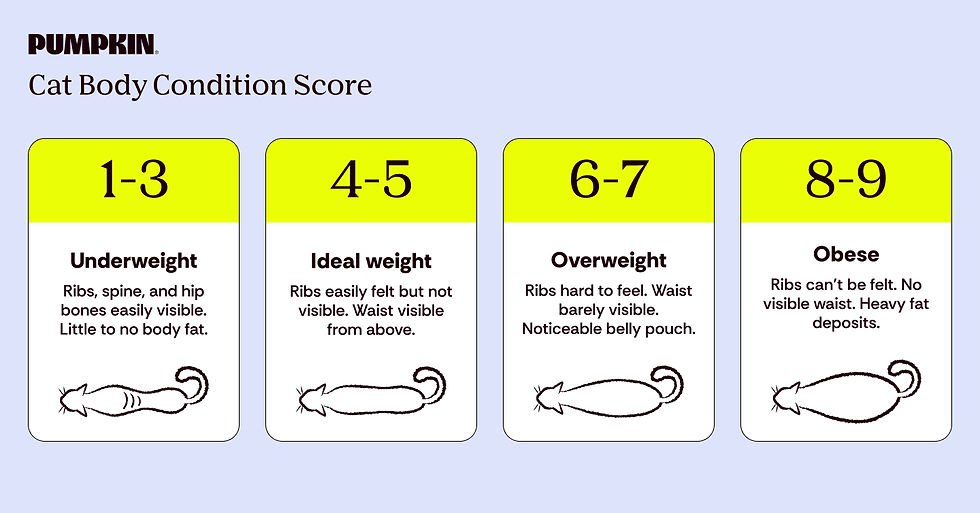
The Body Condition Score uses a one-to-nine scale. Vets use it to evaluate whether your cat is underweight, at a healthy weight, or overweight.
For years, veterinarians faced the same challenge cat owners do today: a healthy weight can look very different from one cat to another. An 18-pound Maine Coon might be perfectly fit, while a 10-pound domestic shorthair could be overweight.
To create a more consistent way to evaluate body fat, veterinary nutritionist Deborah Laflamme developed and validated the nine-point Body Condition Score (BCS) system for cats in 1997. Instead of focusing on the number on the scale, the system evaluates physical features such as rib coverage, waist definition, and abdominal fat.
Today, BCS is one of the most widely used tools for assessing a cat's weight and overall condition.
BCS score | Category | What it means |
1 – 3 | Underweight | Ribs, spine, and hip bones easily visible. Little to no body fat. |
4 – 5 | Ideal weight | Ribs easily felt but not visible. Waist visible from above. |
6 – 7 | Overweight | Ribs hard to feel. Waist barely visible. Noticeable belly pouch. |
8 – 9 | Obese | Ribs can't be felt. No visible waist. Heavy fat deposits. |
How to check your cat's Body Condition Score at home
While your vet can assign an official score, you can perform a simple check at home in less than a minute.
Step 1: Feel your cat's ribs
Run your fingers gently along your cat's ribcage, just behind the front legs.
If you can feel the ribs easily under a thin layer of fat, your cat is likely close to an ideal weight.
If the ribs feel very prominent with little padding, your cat may be underweight.
If you have to press firmly to find the ribs, your cat may be overweight.
Think of it like feeling the back of your hand versus your knuckles. Healthy ribs should be easy to find without feeling sharp or hidden.
Step 2: Look for a waist from above
Stand above your cat while they're standing naturally.
A healthy cat should have a noticeable waist behind the ribs.
If the body forms a straight line from ribs to hips, your cat may be overweight.
If the waist is extremely narrow or the hip bones are obvious, your cat may be underweight.
Step 3: Check your cat's profile
View your cat from the side while they're standing.
A healthy cat should have a slight upward tuck from the ribcage toward the hind legs.
A rounded or sagging abdomen can indicate excess weight.
A very severe tuck may suggest your cat is underweight.
Step 4: Consider your cat's coat
Long-haired cats can be surprisingly difficult to evaluate visually. If your cat is especially fluffy, rely more on your hands than your eyes when checking body condition.

How to tell if your cat is overweight or underweight
Weight changes aren't always obvious, especially in long-haired cats. In many cases, changes in behavior, mobility, or appearance are the first signs that something may be off.
Signs your cat may be overweight:
Gets winded or tired more quickly during play
Hesitates before jumping onto furniture or countertops
Belly hangs low or sways when they walk (some cats have a primordial pouch, which is normal)
Has difficulty grooming hard-to-reach areas
Develops a larger belly or fat deposits near the lower back
Signs your cat may be underweight:
Feels noticeably lighter when picked up
Loses muscle along the spine, hips, or shoulders
Has less energy than usual
Develops a dull or unkempt coat
How to weigh your cat at home
Keeping an eye on your cat's weight between vet visits can help you catch small changes before they become bigger concerns.
Method 1: Use a bathroom scale
Weigh yourself and record the number.
Pick up your cat and step on the scale again.
Subtract your weight from the combined weight.
For example, if you weigh 150 lbs and the scale reads 160 lbs while holding your cat, your cat weighs 10 lbs.
Method 2: Use a baby scale
If you have a kitten or need a more precise measurement, a baby scale can measure small weight changes more accurately than a standard bathroom scale.
For the most useful results, weigh your cat at the same time of day and record the numbers in your phone or a notebook. Even a one- to two-pound change can be significant for a cat and may warrant a call to your veterinarian.
When to see your vet about your cat's weight
Schedule a vet visit if your cat has gained or lost weight suddenly. Rapid changes can signal diabetes, hyperthyroidism, or kidney disease.
At the appointment, your vet will likely:
Weigh your cat and calculate their BCS
Check for underlying health issues
Set a target weight based on breed and frame
Recommend a feeding plan with specific portions
How to help your cat reach a healthy weight
Whether your cat needs to gain weight, lose weight, or maintain their current condition, gradual changes and regular monitoring are key.
Work with your vet on a plan. Don't put your cat on a crash diet – rapid weight loss in cats can cause hepatic lipidosis.
Measure meals. The Cornell Feline Health Center recommends feeding for your cat's ideal weight.
Cut back on treats. Treats should make up no more than a tenth of daily calories.
Increase activity. Aim for 15 – 20 minutes of active play per day.
Schedule regular vet visits. Monthly weigh-ins help you track progress. Preventive care can help you stay ahead of health issues.
Why a healthy weight matters for your cat
Cats carrying extra pounds face a higher risk of diabetes, arthritis, heart disease, urinary problems, and chronic disease.
On the other end, unexpected weight loss can signal hyperthyroidism, kidney disease, or cancer. If your cat is eating normally but dropping weight, call your vet right away.
Whether your cat is a sleek little athlete or a professional couch lounger, the goal isn't to hit a magic number on the scale. It's to help them maintain a healthy body condition so they can enjoy more years of chasing toys, lounging sunbeams, and acting as an appropriately weighted blanket.

FAQ about cat weight
How much should a healthy cat weigh?
Most healthy adult cats weigh between eight and 12 lbs. A BCS check is more reliable than weight alone. Your vet can help set a target at your next visit.
How do I know if my cat is overweight?
Try the rib test. If you can't feel ribs without pressing firmly, they may be carrying extra weight. Your vet can confirm with a BCS assessment.
Does spaying or neutering affect a cat's weight?
Yes. Spaying or neutering can affect your cat's metabolism, appetite, and calorie needs.
When should I be concerned about my cat's weight?
Talk to your vet if your cat has gained or lost weight rapidly. Sudden changes can point to diabetes, hyperthyroidism, or kidney disease. Even a one- to two-pound change in a cat can be significant.