Somewhere in America right now, a dog is overdue for a checkup. The dog’s parent knows it, but they also remember the last vet bill, and they’ve decided the exam can wait.
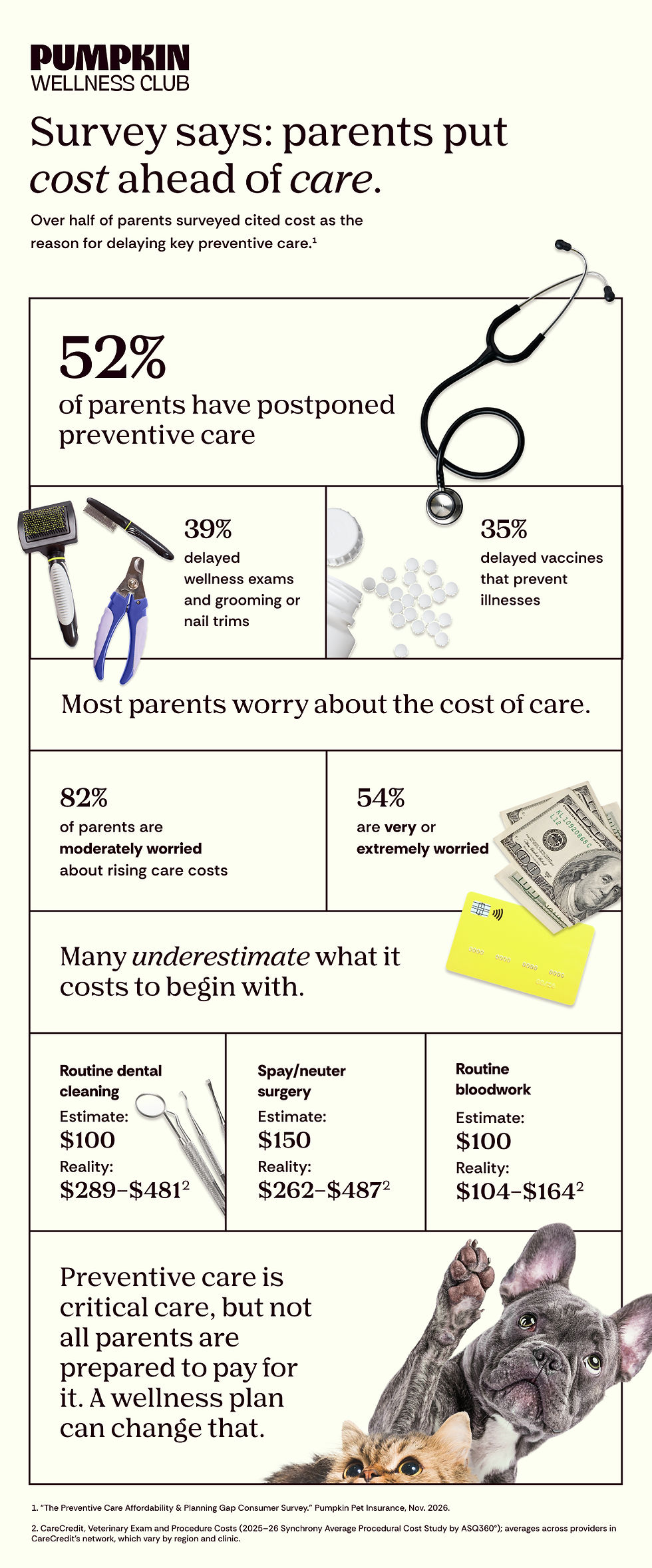
In our November 2026¹ survey of 400 US pet parents, 51.5% said they’d delayed preventive care because of cost. This includes the routine stuff vets recommend: the annual exam, vaccines, blood draw, maybe a dental cleaning. It’s during these ordinary visits that vets catch small problems before they become big, expensive emergencies.
For the most part, these parents are not neglectful. They’re budgeting, and the numbers don’t always add up. Now with Black Friday deals on pet toys, food, and gear, that math is about to be tested.
Key findings
51.5% of pet parents have delayed preventive care because of cost.
Wellness exams are the most-delayed service (39% of delayers), tied with grooming, and ahead of vaccines (35%).
Multi-pet households delay the most: 61%, versus 47% of dog-only parents.
Surprise predicts delay. 71% of parents who are always surprised by routine costs have put off care, versus 3% of those who are never surprised.
A budget is not a safety net. 54% of parents with a dedicated monthly pet budget still delayed care.
Table of Contents:
What parents delay most: wellness exams and more
Among the pet parents who delayed care, 39% put off the dog or cat wellness exam as well as grooming. Vaccines follow at 35%, then bloodwork (30%), routine dental care (28%), spay or neuter surgery (25%), flea and tick preventatives (23%), and fecal tests (18%).
Across all 400 respondents, about 20% have delayed a wellness exam and 18% have put off vaccines.
The wellness exam is easy to defer because nothing seems wrong. A healthy-looking dog or cat does not announce that it is overdue, and the exam itself produces no visible product – only the vet's reassurance or, occasionally, a warning. The reality is, the annual dog wellness exam and cat wellness exam are when veterinarians catch weight changes, dental disease, heart murmurs, and early signs of kidney trouble. And it’s often before a parent would notice anything. Cats are a particular worry, since they’re notorious for hiding discomfort.
Our data suggest the pattern holds across species, with some variation. Among delayers, 39% of dog-only parents and 32% of cat-only parents put off a wellness exam. Parents with both dogs and cats were the most likely to postpone it, at 46%.
Skipping grooming or nail trims is a different matter, and a less consequential one. The real concern lies with the fact that more than a third of delayers put off vaccines, and nearly three in ten put off bloodwork, the test that gives vets a baseline for a pet’s health.
Who delays most: multi-pet households and women
The more pets, the more likely parents are to defer care. Among households with both a dog and a cat, 61% have delayed preventive care, compared with 52% of households with a cat and 47% with a dog alone. The obvious explanation is multiplication: every exam, vaccine, and dental cleaning is paid for twice.
When multi-pet parents put off care, the wellness exam was again first in line. Of those who delayed, 46% skipped or postponed a wellness exam for at least one pet.
The study revealed a gender gap as well. While 55% of women have delayed care because of cost compared to 44% of men, the reason is unknown. One note: women accounted for 66% of the sample.
Surprise at the cost drives delays in care
The sharpest divide we found is not between pet parents who do and don’t budget. It’s between parents who are surprised by prices and those who are not. Some 85% of parents say they have been surprised by the cost of routine care at least some of the time. Nearly half (48%) say they are always or often surprised.
The impact is clear. Among the 96 respondents who say they are always surprised, 71% have delayed preventive care. Among the 31 respondents who say they are never surprised by routine costs, just one (3%) has put off care.
While the results don’t explain cause and effect, the pattern is steep and consistent. Parents who delay care may feel more surprised by the bill when prices have gone up since their last visit – or a surprising bill may push them to put off the next one. Either way, parents who can’t predict what care will cost are most likely to skip it.
Surprised by routine care costs | Delayed care because of cost |
Always | 71% |
Often | 59% |
Sometimes | 47% |
Rarely | 36% |
Never | 3% |
How well do parents estimate cost?
When asked to estimate the cost of a wellness exam, only 38.5% of parents felt confident about their answer. For fecal tests, it fell to 21%.
Confidence was higher for more frequent care: vaccines (67%), flea and tick preventatives (55%), and grooming (44%). It was lower for clinical care like bloodwork (33%), spay or neuter procedures (25%), and routine dental cleanings (25%). One in eight parents (12.5%) was not confident about their estimates at all.
Parents’ guesses show why. The median guess for a wellness exam was $80, but the middle half of respondents ranged from about $49 to $150 – a wide spread for what is one of the most standardized services vets offer. Guesses for vaccines, bloodwork, fecal tests, and dental all show the same pattern, with the middle half of answers running from $50 to $200.
Service | Median guess |
Wellness exam | $80 |
Vaccines | $100 |
Bloodwork | $100 |
Fecal test | $100 |
Routine dental | $100 |
Spay or neuter | $150 |
Flea and tick preventative | $60 |
Grooming or nail trims | $60 |
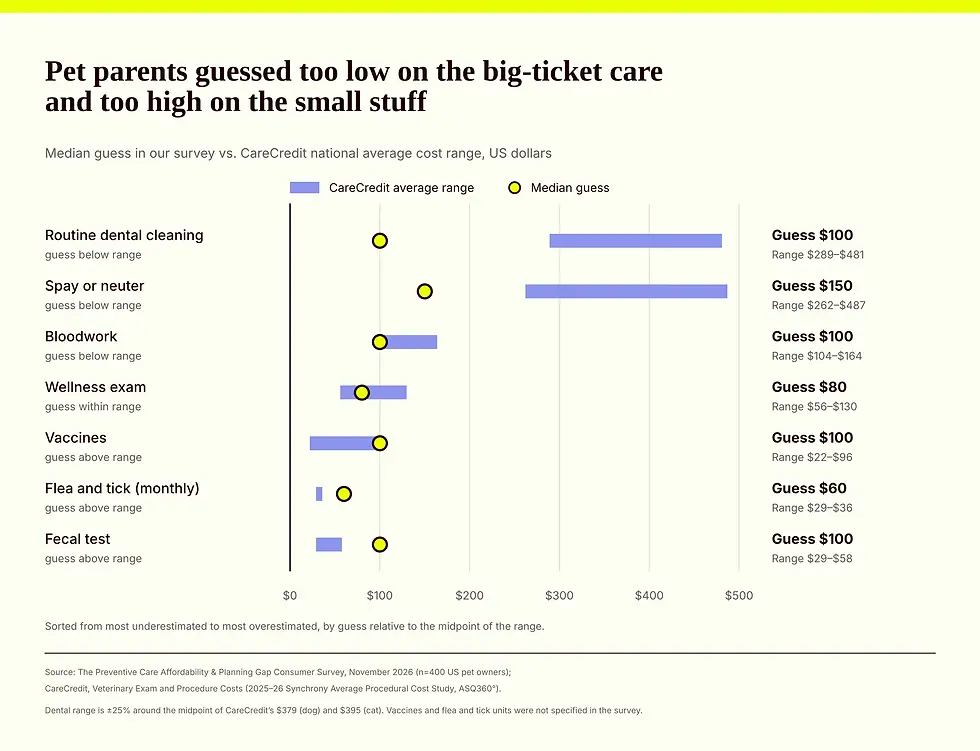
Source: CareCredit, Veterinary Exam and Procedure Costs, based on the 2025–2026 Synchrony Average Procedural Cost Study for Veterinary Practices, conducted by ASQ360° Market Research. Accessed November 17, 2026.
Compared with CareCredit's national averages, 81% of parents guessed too low for a routine dental cleaning, 72% guessed too low for spay or neuter surgery, and 53% guessed too low for bloodwork. On cheaper, more frequent items, the opposite happened: 63% guessed too high for vaccines and 61% guessed too high for fecal tests. They were closest on wellness exams with a median guess of $80 – inside the CareCredit range.
Budgeting: a plan isn't a safety net
Pet parents are advised to set money aside for care. Many have: 57% of respondents have a dedicated monthly budget for their pet. But having a budget did not stop parents from skipping care. Among budgeters, 54% still delayed preventive care because of cost, compared with 49% of those who don’t budget.
One likely reason: a monthly budget assumes steady spending, but vet costs aren’t steady. A budget for food and toys doesn’t easily absorb fees for an exam, vaccines, and bloodwork in the same month, and our data suggest parents don’t know how big the bill will be.
Parents are also uneasy about where prices are headed: 54% are very or extremely concerned about rising pet care costs. Despite this, 35% of parents said the most they feel comfortable spending in a year is higher than what they spend now. For some, we think, the barrier is less willingness than predictability.
Black Friday and the pet parent's deal hunt
We fielded the survey in early November, before the holiday shopping rush, and didn’t ask about Black Friday. But our findings suggest where a deal-hunting parent's money matters most.
The discount parents valued least is one the season is built around. Ultimately, they want savings on the vet bill, not the toy aisle. Vaccine support (49%) and predictable monthly costs (42%) ranked first and second on their wish lists, while deals on pet toys came in last.
It matters because the people most likely shopping for bargains are the ones feeling the squeeze. 54% of parents are very or extremely concerned about rising pet care costs, and 85% have been surprised by a routine bill at least some of the time. A $20 deal on a chew toy will not offset a $150 exam fee they didn’t anticipate.
Tips for parents using Black Friday deals to stretch their pet budget, based on the data:
Shop deals on food and supplies, then put your savings toward care. Moving even some of the money into a dedicated vet care fund addresses the gap budgets didn’t close.
Price the wellness exam before the season ends. Only 38.5% feel confident guessing the fee, so call the clinic and ask for a written estimate for routine care.
Look for plans that make care predictable. A fixed monthly cost removes the surprise that leads to delays in care.
Our take? A bargain that leads a pet parent to skip the annual exam is not a bargain.
How to make preventive care more affordable
When parents were asked to rank what’s most valuable in a preventive care program, vaccine expenses (49%) and predictable monthly costs (42%) came out on top. Cash back on routine care, wellness reminders, dental care savings, and grooming savings each landed around 33%, with pet toys coming in last.
The two leading answers fit everything else we found. Vaccines are one of the most commonly delayed services, and surprise at the price is closely linked to delay. The result suggests what parents want most is to know costs upfront and spread them across a year.
That’s the idea behind Pumpkin Wellness Club, which pairs support for routine care like vaccines with a predictable monthly cost. For pet parents who have quietly pushed back an appointment, a fixed monthly figure may be easier to commit to than a bill of unknown size. Plus, it’s a deal that doesn’t end with holiday sales.
If you’re putting off a dog or cat wellness exam, check what your vet charges for it, and ask what a year of routine care will cost before you decide it can wait.
How we ran the study
We surveyed 400 US pet parents in November 2026. Every respondent had at least one dog or cat. At this sample size, the margin of error is about ±5 percentage points at the 95% confidence level.
Our sample skews young and female. The median respondent is 33, and 57% are 35 or younger. Women make up 66% of respondents (262), men 33% (131), and 2% (7) identified as another gender. We ask readers to keep that skew and the margin of error in mind when comparing subgroups, particularly small ones.
References:
1. All information is taken from the results of The Preventive Care Affordability & Planning Gap Consumer Survey, November 2026.