
Updated: Aug 4
Key Points
Stay calm in a pet emergency to get your dog or cat to the ER as quickly as possible.
There are non-negotiable emergencies, and it’s your job to know what they are.
You should have first aid items on hand, but they’re not always the smartest choice.
We’ve all been there: Your dog is enjoying a lovely spring day and decides to ingest a pretty flower — that happens to be a toxic tulip. Or maybe your cat overestimated just how talented he is at indoor parkour — and fell from a pretty big height.
Laura Veals, DVM, a veterinarian with VEG Beaverton in Oregon recently found herself in an emergency situation with her dog, Ryna, who had eaten the plastic eye of a stuffed animal.
“Suddenly I was in the same position I’ve guided so many pet parents through: feeling panicked, worried, and hoping I was overreacting, but knowing I wasn’t,” she says.
Ryna ended up being fine, but it reminded Dr. Veals “just how overwhelming a pet emergency can feel when you’re on the other side of the exam table.”
So, what do veterinarians wish pet parents knew in an emergency? We asked Dr. Veals and two other veterinarians: Adam Grochowsky, DVM, a veterinary critical care specialist at Thrive Pet Healthcare partner Capital Veterinary Services Jax in Jacksonville, Florida, and Sabrina Kong, DVM, a staff veterinarian at We Love Doodles.
1. It’s your job to have an emergency vet contact
“Preparation isn’t paranoia,” says Dr. Kong.
If your dog is having a seizure, that’s no time to be googling the nearest emergency veterinarian. Plan ahead and find an emergency vet that’s open 24 hours. It’ll vary depending on where you live, but popular options in the U.S. include Blue Pearl, VCA, and VEG.
Also save the Pet Poison Helpline and the ASPCA Poison Control Center in your phone in case your pet ingests something toxic.
2. Know what’s a non-negotiable pet emergency
It would be a wonder if animals could speak to us in a language we understood, but since they can’t, we sometimes have to decode when an issue is minor or when to see an emergency vet, stat.
Always head to the emergency vet if your best friend:
Eats something poisonous
Has bleeding that lasts more than a few minutes
Has an eye injury
Has difficulty breathing, walking, or urinating
Is choking or gagging
Has a broken bone or can’t move their legs
Experiences any sort of body trauma
Has a seizure
Has heatstroke
Has a pale or blue tongue or gums
Is unresponsive in any way
Is clearly in pain (for example, vocalizing distress)
“Trauma patients, especially car accidents, should always be examined emergently,” Dr. Grochowsky says, even if they seem OK. “Internal injuries and the delayed effects of shock may not be apparent for 48 hours.”
A single episode of vomiting or diarrhea in an otherwise healthy cat or dog with no other symptoms is generally something you can wait on, Dr. Grochowsky says.
But frequency and history are key: If your pet is vomiting two or three times a day or already has a serious illness, like kidney disease or heart disease, go to the ER vet.
3. You need to calm down
“I can't stress this enough: Stay calm,” Dr. Kong says. “Pets mirror our energy, and frantic movements only escalate their fear.”
She suggests rehearsing the route to your nearest 24-hour clinic now, not during a crisis.
“In an emergency, every second counts, but knowing how to act can mean the difference between panic and life-saving care,” she says.
4. First aid isn’t always the best choice
“First aid is a bridge to professional care, not a substitute,” Dr. Kong says.
That said, here are some items that should be staples in your pet’s first-aid kit:
Leash and collar for transport
Muzzle (never muzzle a pet who is vomiting, coughing, or having trouble breathing)
Bandages and gauze
Field tourniquet
Sturdy blanket (to use as a makeshift stretcher)
Collapsible water bowl
Digital thermometer
Hydrogen peroxide (for vet-approved vomiting)
If your dog or cat is choking, you might be able to remove the object with your fingers, but they may require the Heimlich maneuver. Even if they are OK afterward, you should head to the vet.
If a pet has stopped breathing, “CPR can buy time,” Dr. Kong says. But you must know what you’re doing. Learn beforehand how to give your dog CPR or your cat CPR, and you can also check out a CPR course.
Most of the time, however, it’s best to get to the ER ASAP.
“First aid outside of the hospital can help minimize some injuries and can even be lifesaving, but this would be in an idealized situation where the injured patient is cooperative and the owner has some medical training,” says Dr. Grochowsky.
Exceptions would be applying pressure to a bleeding wound and minimizing the movement of any injured limbs during transport (with a splint, for instance), according to Dr. Grochowsky.
5. You are your dog or cat’s ambulance
As the Schwarzman Animal Medical Center in New York City puts it, “when your pet is injured, you become the EMT and the ambulance driver.”
If you need to transport a small dog, a sturdy blanket or their pet bed can work as a cushion or stretcher. You can also use a box, carrier, or crate, or hold them in your arms with their injured side against your body.
If your dog is not portable, have a stroller or child’s wagon available. The AMC even recommends a wheeled pet stretcher, particularly for people who live alone with large dogs.
Cats tend to be jumpier, so place them in a box or carrier. Dr. Kong recommends a nonslip mat inside the carrier and a blanket over it to block “visual overstimulation.”
If you don’t have access to a box or carrier, wrap them in a towel and rush them to the vet.
“Never delay care because you can’t find the carrier,” Dr. Kong says. “A sturdy box or laundry basket will work in a pinch.”
If your pet has a broken bone, you may be able to construct a cardboard or towel splint, but you should transport these pets on a flat surface, like a board or blanket, to prevent spinal damage, Dr. Kong says.
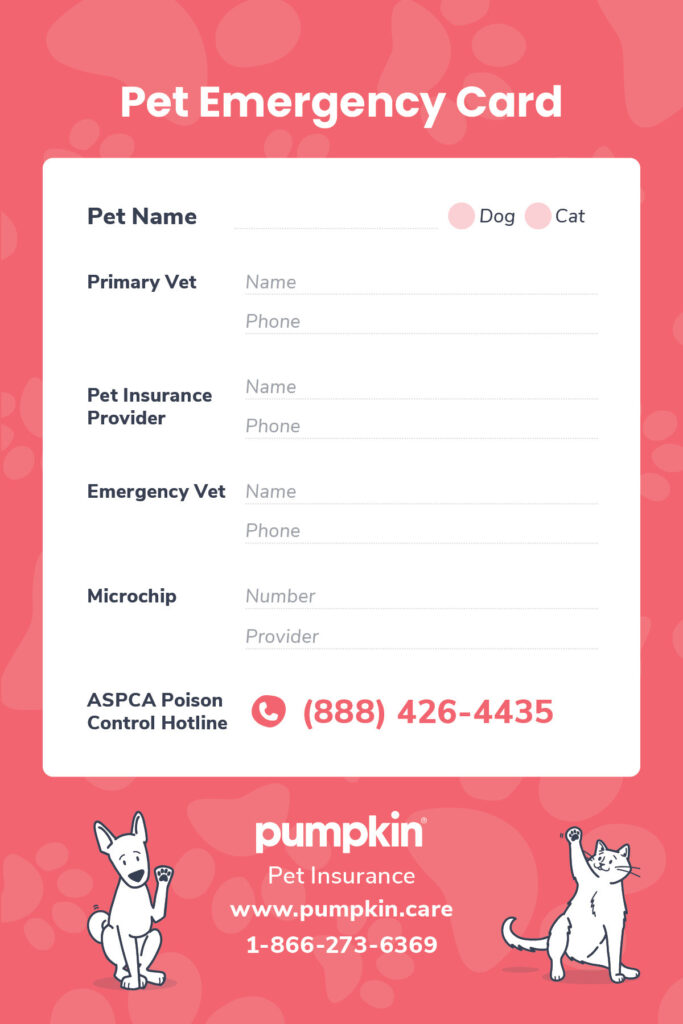
Stay prepared for any pet emergency by filling out this emergency card.
6. You’re also your pet’s spokesperson
No one else is going to speak for your pet — that’s your job, so be ready with this info:
Your pet’s symptoms and when they started
Medical history and any medications
When your pet last ate, drank, peed, and pooped
Any toxins or anything else dangerous or unusual they’ve been exposed to
“If your pet got into a medication or toxin, bring the packaging,” says Dr. Veals. “If they’ve recently been to another vet, please let us know where — we may be able to call for records.”
“Bonus brownie points if you know your pet’s medications and dosages, or have a photo of the bottles,” she adds. “That kind of information can be lifesaving.”
7. Pet insurance can make an emergency much simpler
Most pet insurances are designed to cover veterinary expenses for unexpected accidents & illnesses. Unlike human health insurance, pet insurance typically works on a reimbursement model. That means pet owners pay a monthly or yearly premium, then submit a claim with a copy of their vet’s invoice after paying upfront for treatment.
Once they meet their deductible, they get reimbursed for a certain percentage of covered vet bills, depending on the plan they’ve chosen.
“Pet insurance can truly make a difference,” says Dr. Veals. “We’ve seen the relief on people’s faces when they realize they can move forward with diagnostics or treatment because they’re covered. It doesn’t make the emergency less scary, but it can make the decisions easier, and that kind of power in planning truly matters.”
8. But your vet still hates that care costs so much
Even though pet insurance can be a game-changer in emergencies, your vet still hates that it costs so much. “Veterinary care, especially in emergencies, can be expensive,” says Dr. Veals. “We wish it weren’t.”
For example, a pet ultrasound can cost between $600 to $900, but might be necessary in an emergency.
“Most of us went into this field because we love animals, not because we wanted to talk about money during a crisis,” Dr. Veals says. “But ER clinics run 24/7 with specialized equipment, highly trained staff, and intensive care—and that adds up quickly.”
The good news is, pet insurance providers like Pumpkin are innovating new ways to help reduce cost barriers and alleviate financial stress in emergency situations like these. In fact, Pumpkin recently launched PumpkinNowTM — an urgent pay service that can expedite eligible claims when pets need critical, high-cost care.
“When your pet is seriously hurt or sick, choosing the best treatment shouldn’t be a cost decision,” says Christie Ross, Director of Customer Care at Pumpkin. “In these stressful moments, pet parents should be able to focus on giving quality care — not worry about high upfront costs or when they’ll get a reimbursement check in the mail. This is why we created PumpkinNow, a new service that can fast-track eligible claims for critical care and pay pet parents up to 90% of covered expenses in just 15 minutes – before they even pay or leave the vet!”¹
9. The ER might not have answers immediately
Even with all that equipment and diagnostics, sometimes finding out what’s wrong takes time.
“Pets can’t tell us where it hurts. Diagnosing what’s wrong often takes time, tests, and patience,” says Dr. Veals. “We’ll usually start with the basics: vital signs, a physical exam, followed by bloodwork, ultrasound, and X-rays.”
She understands that it can be frustrating to not know immediately, but she assures pet parents vets are doing their best: “Emergency medicine is often a process of ruling things out just as much as it is discovering what’s wrong.”
10. But delaying treatment is never the answer
All that uncertainty might have you wondering if you should wait it out. Maybe you want to believe the best (it’s only a little vomit!), but waiting is never the answer.
“One dog may be vomiting because it ate rotten food an hour ago, or another dog may be vomiting because it developed severely elevated kidney values a week ago and is now in kidney failure,” Dr. Grochowsky says.
While the first dog could probably hold off to see the vet, the second dog’s condition is serious — and there’s no way for a pet parent to know the difference.
“A 12-hour wait would significantly worsen the prognosis and increase the length of hospitalization,” says Dr. Grochowsky.
11. Your vet gets what you’re going through
In any emergency, everything feels scary. Dr. Veals says she and her colleagues understand the sentiment.
“We’ve totally panicked when our dogs suddenly started limping, or our cats stopped eating,” she explains. “We know how hard this is. So, if you’re scared, overwhelmed, or emotional, it’s OK to feel that way. We’ve got you.”
Being prepared means you love your pet
With proper preparation and helpful tools like pet insurance, you could not only make things easier on yourself, but show an act of love toward your pet — and get them in the hands of people who can help.
Says Dr. Veals: “Take a deep breath, trust the process, and know that we’ve got your back no matter what comes through our doors.”
FAQs
Is there a 911 for pet emergencies?
There is no 911 for pet emergencies, so have an emergency vet contact in your phone. If your dog or cat has eaten something toxic, try the Pet Poison Helpline or the ASPCA Poison Control Center first.
What is the most common pet emergency?
According to Dr. Grochowsky, vomiting and/or diarrhea are the most common reasons pets are at the emergency room. “This is because 10-plus body systems can cause these symptoms,” he says.
How much is an emergency vet visit?
The average cost of an emergency vet visit in the U.S. is $653 for dogs and $919 for cats, based on claims filed by Pumpkin Pet Parents between February 2022-2025, but that’s just to be seen. Blood tests, X-rays, ultrasounds, hospitalizations, and more usually turn into hundreds or thousands of dollars.
Does pet insurance cover emergency visits?
When emergencies happen, pet insurance can help cover vet bills for accidents & illnesses, but the reimbursement amount depends on many factors. Pumpkin Pet Insurance customers may also be able to benefit from PumpkinNow, a new urgent pay service that expedites eligible claims in critical care situations.
1. Qualified customers with eligible claims for treatments $1k or more could be paid in 15 minutes after submitting a request if their bank accepts real-time payments. For a list of RTP-enabled banks, visit https://www.theclearinghouse.org/payment-systems/rtp/rtp-participating-financial-institutions. For full terms & conditions, visit www.pumpkin.care/pn-terms. Pumpkin Pet Insurance policies do not cover pre-existing conditions. Waiting periods, annual deductible, co-insurance, benefit limits and exclusions may apply. For full terms, visit pumpkin.care/sample-plan. Products, schedules, and rates may vary and are subject to change. Discounts may vary and are subject to change. Premiums are based on and may increase or decrease due to the age of your pet, the species or breed of your pet, and your home address. Insurance products are underwritten by either Independence American Insurance Company (NAIC #26581. A Delaware insurance company headquarters located at 11333 N. Scottsdale Rd, Ste. 160, Scottsdale, AZ 85254), or United States Fire Insurance Company (NAIC #21113. Morristown, NJ). Please refer to your policy forms to determine the underwriter for your policy. Insurance is administered and produced by Pumpkin Insurance Services Inc. (“Pumpkin”) (NPN #19084749; Domiciled in New York with offices at 666 3rd Avenue, Floor 23, New York, NY 10017; CA License #6001617). Pumpkin is a licensed insurance agency, not an insurer, and receives compensation based on the premiums for the insurance policies it sells. For more details, visit pumpkin.care/underwriting-information.